Researchers at a Chinese university last month allegedly handed over control of a satellite to an artificial intelligence (AI) program for 24 hours, showing how far the country will go to find ways to get ahead using AI technology, experts warn.
“Many Americans understandably want to hit the pause button on AI development to sort out the risk issues. China, unfortunately, is roaring ahead, as its 24-hour satellite experiment shows,” Gordon Chang, a China expert, told Fox News Digital.
Researchers at Wuhan University allegedly handed over control of the Qimingxing 1, a small Earth observation satellite, to a ground-based AI program. The program had freedom, with no human orders, assignment or intervention, the South Morning China Post reported. The researchers developed the AI using data from around the globe, creating it not to chat but to take initiative based on its training and growing understanding of natural and human activities.
Lead researcher Wang Mi said that the experiment broke the rules of mission planning, which requires satellites to have specific orders or assignments before taking action.
“The Communist Party’s only regulation of the technology is to make sure that nobody uses AI to criticize, mock or otherwise undermine its rule,” Chang said. “Because we don’t want to live in a world where Chinese communists dominate AI, we have no choice but to continue development as fast as we can. China can, single-handedly, prevent humanity from adopting safeguards.”
“The bottom line: Chinese communists will do anything, which means we must match them step for step in AI,” he added. “This is not an ideal outcome, but ideal outcomes are not possible.”
AI-ASSISTED ‘SOCIAL LISTENING’ CAN HELP TRACK HUMAN RIGHTS ABUSES AND MAP OUT ETHICAL SUPPLY CHAINS
In fact, AI will likely make it easier for programming satellites since they only make contact with ground stations “a handful of times” in a typical 90-minute orbit, Clancy noted.
SOUTHERN CALIFORNIA STARTUP VAST ANNOUNCES PLANS TO LAUNCH WORLD’S FIRST COMMERCIAL SPACE STATION
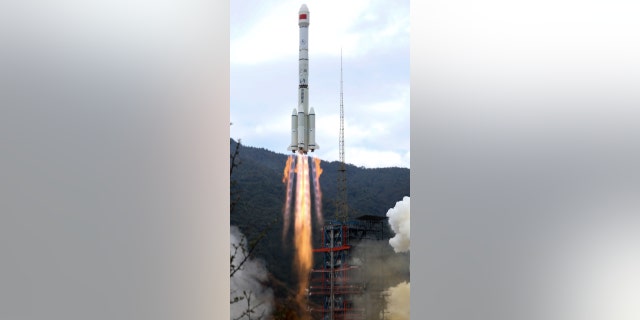
A rocket carrying a satellite blasts off from the Xichang Satellite Launch Center on Dec. 29, 2022, in Xichang, China. (Li Jieyi/VCG via Getty Images)
Matt McInnis, a senior fellow for the Institute for the Study of War’s China Program, told Fox News Digital that Beijing views AI as the key tool to help it “leapfrog” the U.S. military for superiority and “allow them to make decisions in potential conflicts much quicker and more accurately.”
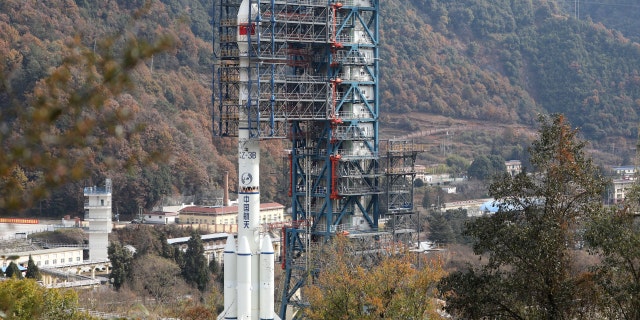
XICHANG, CHINA – December 29: A Long March 3B carrier rocket carrying the Shiyan-10 02 satellite is ready to blast off from the Xichang Satellite Launch Center on December 29, 2022 in Xichang, Liangshan Yi Autonomous Prefecture, Sichuan Province of China. ((Photo by Li Jieyi/VCG via Getty Images))
FOX NEWS POLL INDICATES VOTERS FEAR AI IS BAD FOR SOCIETY
“I think that’s really where China wants to go, where they can do it all in the AI-enabled cycle,” he added.
“As China continues to modernize, will they be willing, on the one hand, to give up or to allow artificial intelligence to make decisions that have traditionally resided with humans or humans processing information? Are they going to truly develop AI that they can trust and be able to control?” he said.