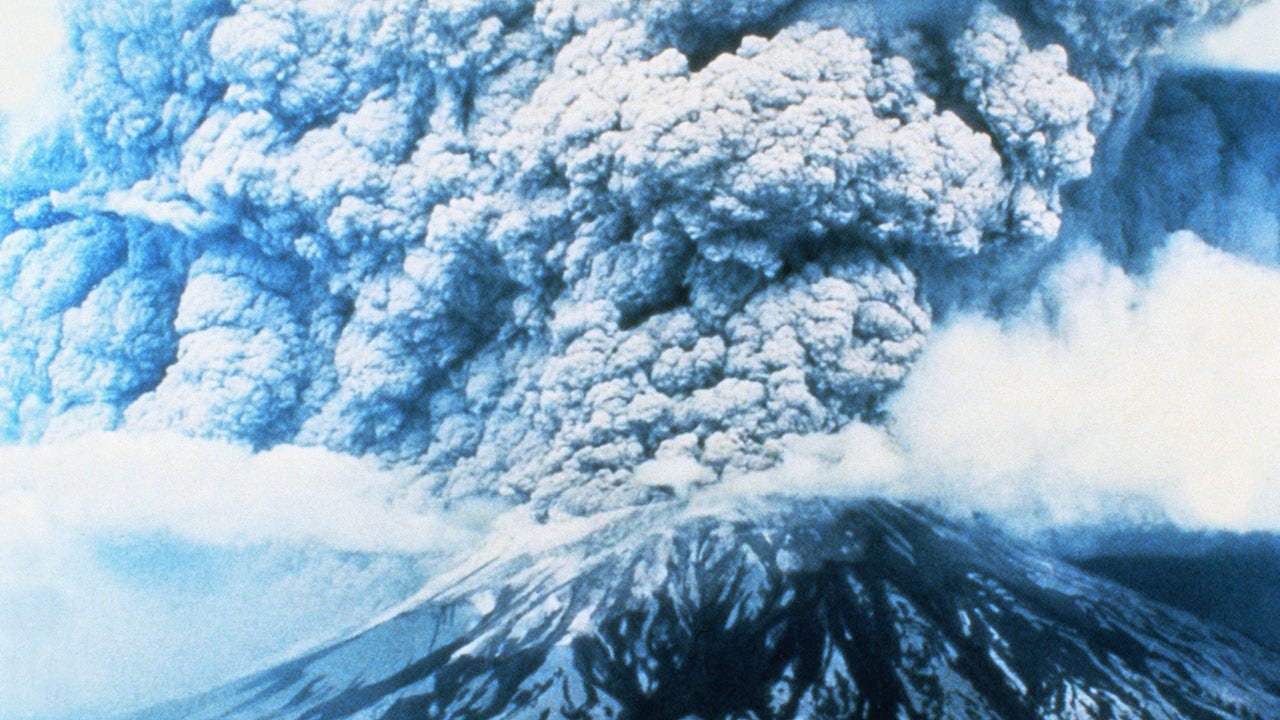
Washington’s Mount St. Helens erupted for nine hours on this day in history, May 18, 1980 — killing 57 people and triggering the largest landslide in recorded history.
Prior to the eruption, Mount St. Helens stood at 9,677 feet, says the website for the United States Geological Survey (USGS). It was the fifth-tallest mountain in the state of Washington.
“It stood out handsomely, however, from surrounding hills because it rose thousands of feet above them and had a perennial cover of ice and snow,” said the site.
Instead, there was a horseshoe-shaped crater in its place, says the USGS.
In that eruption, “steam explosions blasted a 60- to 75-m (200- to 250-ft) wide crater through the volcano’s summit ice cap and covered the snow-clad southeast sector with dark ash,” said the USGS.
These eruptions continued through April 22, said the USGS.
ON THIS DAY IN HISTORY, AUGUST 25, 1916, NATIONAL PARK SERVICE CREATED UNDER PRESIDENT WILSON
At 8:32 a.m. on May 18, a 5.1 earthquake “with no immediate precursors” struck Mount Saint Helens, triggering “a rapid series of events,” said the USGS.
“At the same time as the earthquake, the volcano’s northern bulge and summit slid away as a huge landslide — the largest debris avalanche on Earth in recorded history,” they said.
The landslide had removed part of the “cryptodome,” which was “a very hot and highly pressurized body of magma,” said the USGS.
With the cyptodome removed, Mount St. Helens’s magmatic system depressurized, triggering “powerful eruptions that blasted laterally through the sliding debris,” knocking 1,000 feet off the height of the mountain.
AMERICA THE BEAUTIFUL: 50 MUST-SEE LANDMARKS THAT TELL OUR NATIONAL STORY
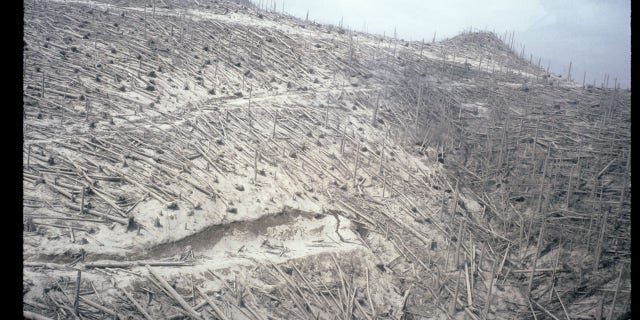
The formerly dense forest surrounding Mount St. Helens was flattened in the landslide and eruption in May 1980. (Getty Images)
“The 600 km2 (230 mi2) devastated area was blanketed by a deposit of hot debris carried by the blast,” the site said.
The eruption then became a “Plinian eruption,” defined as “as one that produces a sustained convecting plume of pyroclasts and gas rising >25km above sea level,” says the website Science Direct.
ON THIS DAY IN HISTORY, MARCH 1, 1872, MAJESTIC YELLOWSTONE BECOMES AMERICA’S FIRST NATIONAL PARK
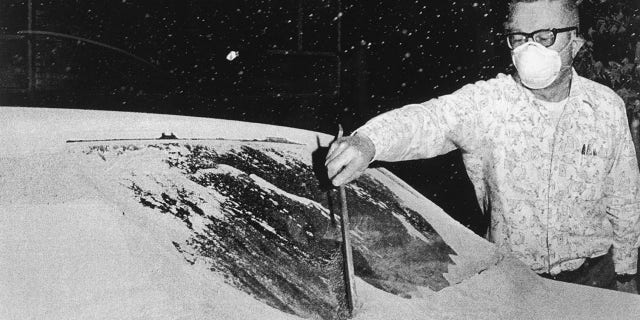
Rick Cole, director of emergency services for Yakima, is shown brushing volcanic ash off his car. (Getty Images)
“Major ash falls occurred as far away as central Montana, and ash fell visibly as far eastward as the Great Plains of the Central United States, more than 1,500 km (930 mi) away,” said the USGS.
“The ash cloud spread across the U.S. in three days and circled the Earth in 15 days.”
ON THIS DAY IN HISTORY, JAN. 28, 1986, SPACE SHUTTLE CHALLENGER EXPLODES, SHOCKING THE NATION
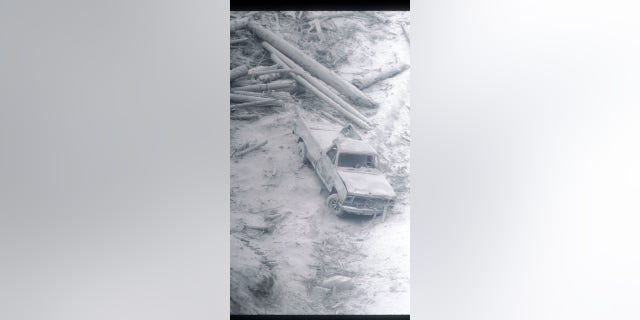
A pickup truck covered in ash and other debris after Mount St. Helens erupted. (Getty Images)
In the weeks leading up to May 18, people who lived near Mount St. Helens were evacuated, according to an article in American Scientist.
The area immediately surrounding Mount St. Helens was divided into a “red zone” and a “blue zone.”
Of the 57 people who died in the eruption, only one — Harry Randall Truman — did not have express permission to be near the mountain the day it erupted, and most of the deaths actually occurred outside the boundaries of the blue zone, said American Scientist.
“My wife and I, we both vowed years and years ago that we’d never leave Spirit Lake. We loved it. It’s part of me, and I’m part of that (expletive) mountain,” he said.
CLICK HERE TO GET THE FOX NEWS APP
Truman’s remains were never found.