China’s new ambassador to the U.S., Xie Feng, is reportedly expected to arrive in Washington, D.C., as soon as Tuesday on the heels of President Biden leading the G7 summit in Japan.
Politico first reported Xie’s impending arrival this week, citing two people familiar with his schedule.
Xie, a career diplomat who specializes in U.S.-China relations, will succeed Qin Gang, who departed Washington in January to become China’s new foreign minister.
Unlike Qin, Xie reportedly does not have a direct line to Chinese President Xi Jinping, which Qin seemingly levied to advance himself to the more senior leadership role.
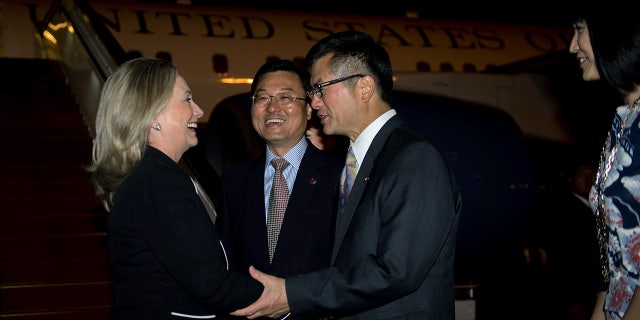
Former Secretary of State Hillary Clinton seen with U.S. Ambassador to China Gary Locke and Director General for North American and Oceanian Affairs Xie Feng in Beijing in September 2012. Xie is reportedly China’s new ambassador to the U.S. (JIM WATSON/AFP/GettyImages)
Yet Xie, while in his previous role as commissioner of the Ministry of Foreign Affairs of China in Hong Kong, did wield a more aggressive style of diplomacy of his own back in 2019 when he publicly alleged “foreign forces” condoned and “even colluded with” mass hordes of pro-democracy protesters.
Large crowds which took to Hong Kong’s streets to protest a bill that would have allowed those accused of crimes to be extradited to mainland China were confronted by heavy-handed police wielding batons and deploying tear gas, pepper spray, rubber bullets and water cannons. Though the extradition bill was scrapped, Beijing’s hand-picked officials in Hong Kong implemented new restrictions on expression and assembly and refused to investigate allegations of excessive use of force.
As China’s vice foreign minister in 2021, Xie chastised U.S. Deputy Secretary of State Wendy Sherman during face-to-face talks, reportedly demanding the Biden administration change its “highly misguided mindset and dangerous policy,” which he alleged contained and suppressed China’s development. After the talks in Tianjin, he reportedly sent Sherman home with a “List of U.S. Wrongdoings that Must Stop” and a “List of Key Individual Cases that China Has Concerns with.”
At a press conference in Hiroshima Sunday, Biden did predict U.S.-China relations would improve.
“Well, number one, you’re right — we should have an open hotline. At the Bali conference, that’s what President Xi and I agreed we were going to do and meet on. And then this silly balloon that was carrying two freight cars’ worth of spying equipment was flying over the United States, and it got shot down, and everything changed in terms of talking to one another,” Biden said in Japan. “I think you’re going to see that begin to thaw very shortly.”
“But in the meantime, what’s happened is: I think it’s fair to say, for those of you who have dealt with — dealt with the Japanese government and reported from here for a long time, the situation in terms of our relations with Japan have never, ever, ever in American history been stronger,” he added.
CLICK HERE TO GET THE FOX NEWS APP
Biden and the leaders of the world’s top democracies expressed there was “no legal basis for China’s expansive maritime claims in the South China Sea,” voiced human rights concerns about Tibet and Xinjiang, demanded China honor Hong Kong’s autonomy, and called on “China to press Russia to stop its military aggression, and immediately, completely and unconditionally withdraw its troops from Ukraine.” In the joint communiqué summarizing their discussions, the G7 leaders also warned that China’s “accelerating build-up of its nuclear arsenal without transparency (or) meaningful dialogue poses a concern to global and regional stability.”
The Associated Press contributed to this report.